
Juvenile Detention Release Path
The Jefferson County Probate and Juvenile Court operates this short-term secure detention center. A departure may involve release to a parent or other authorized custodian, a court-directed placement, transfer, or another juvenile-case outcome. Public adult custody labels do not describe those decisions well, and the research does not establish an open juvenile release list. The responsible Juvenile Court or detention staff must determine what information can be given to the person making the inquiry.
Confirmation should preserve both identity and confidentiality. Provide the information staff request through the authorized channel, then follow the court’s instructions. Do not interpret the lack of a public search result as proof that a young person was released, moved, or never held. An online adult roster is not the controlling source for this facility.
A release question may also be a placement question. The juvenile could remain under court authority after leaving secure detention, and a different authorized custodian or program may become responsible. Only the court or detention center can put the physical move into its proper case context. Avoid describing the event as final discharge unless the responsible office uses that term.
Juvenile Detention Records Contact
The center publishes a separate number and mailing designation. Contact it for authorized information about detention, release, or placement. The adult jail and Sheriff public-record email are not substitutes for a Juvenile Court inquiry, and no public fee, turnaround, or open release-record form was established for this facility.
Detention center
Jefferson County Juvenile Detention Center
16001 State Route 7
P.O. Box 549
Steubenville, OH 43952
Telephone: 740-283-8684
Operator: Jefferson County Probate and Juvenile Court
Ask which Juvenile Court channel applies and what proof of authority is needed. Do not send sensitive juvenile details through unrelated public forms or broad search services. When staff cannot disclose information, that limit should not be treated as evidence about custody status.
Keep the case information private while routing the question. Use the published center contact first, confirm the proper recipient, and transmit documents only by the method staff approve. This reduces the risk of sending protected facts to the adult jail, a general county inbox, or an unrelated search provider.
Protected Juvenile Release Information
Juvenile detention information has different public-record boundaries from an adult booking. Names, photographs, custody details, and placement information must not be presented as an adult-style released-person record. Ohio law also gives juvenile photographs special treatment. The research supports careful routing through the court, not a public gallery, roster, or archive.
A person who has legitimate access may still need a court record, notice, or direct confirmation, but the office determines the lawful route. A denied or limited response can reflect confidentiality rather than missing data. Public curiosity does not create permission to publish a juvenile identity or reconstruct a custody history from scattered sources.
The same caution applies to photos. An adult booking-photo request model should not be copied onto a juvenile case, and a public image should not be assumed to exist. R.C. 2151.313 supplies special rules for juvenile photographs. The safest facility page gives no juvenile identity, image, sample record, or search example.
Adult and Juvenile Records Differ
The Jefferson County Sheriff directs adult jail searches to Ohio VINELink. That adult workflow should not be extended to this Juvenile Court facility. VINE’s public People search, adult booking requests, ODRC offender records, and released-mugshot channels do not become appropriate merely because the Justice Center address appears in both facility descriptions.
| Question | Correct Jefferson channel |
|---|---|
| Adult jail custody event | Sheriff-selected VINE route and jail |
| Adult bond or case disposition | Correct criminal court docket |
| Juvenile detention or placement | Authorized Juvenile Court or center contact |
| State-prison reception | ODRC Offender Search |
The distinction prevents false matches and improper disclosure. It also helps a caller reach the office that can lawfully answer the question instead of asking Sheriff jail staff to interpret a Juvenile Court matter.
Adult court terms such as bond posted, conveyance to ODRC, parole eligibility, and post-release control should not be assigned to a juvenile case without a controlling court record. The facility’s secure nature does not change that rule. Describe only what the authorized court or detention channel confirms, and retain the words that office uses for release, placement, transfer, or continued court authority.
Juvenile Detention Center Role
The county describes the facility as short-term secure juvenile detention and says it serves juvenile courts in Ohio and western Pennsylvania. That role differs from an adult county jail, an ODRC prison, and an EOCC residential community-control program. Its secure setting does not support claims about an adult sentence, parole eligibility, or a public state offender record.
Because the center can serve more than one juvenile court, the responsible court may matter as much as the physical location. Ask staff which court or placement authority controls the case before seeking further documentation. Do not assume that every young person at the Steubenville address has a Jefferson County public docket or that a physical departure ends all court oversight.
Geographic service across state lines also does not make this a regional adult jail. The young person’s referring court and authorized representatives determine the proper inquiry path. A Pennsylvania referral, for example, should not be treated as proof that Jefferson County court records control the matter. Start with center staff and follow the referral information they provide.
Note: A change in juvenile placement does not necessarily end the court case or every condition imposed by the responsible court.
Juvenile Facility Record Context
No separate public release history, online roster, release-feed cadence, or photo-publication policy was established for the juvenile detention center. That negative finding is important because it prevents adult release-page assumptions from filling the gap. It is more accurate to explain the authorized channel than to invent a public archive or quote unsupported operational detail.
The site’s facility map includes the center because it is a real secure detention operation serving juvenile courts, not because its records should be exposed like adult jail data. Research-driven coverage therefore centers on the facility’s identity, operator, contact, shared-address distinction, and protected release route. The absence of a public list is a privacy boundary, not a prompt to search unofficial sources.
No supported facility capacity, public release time, discharge door, transportation rule, or property-return process was found. Those operational details should not be borrowed from adult jail guidance. An authorized person who needs to plan for a court-approved transition should ask detention staff for the current instructions that apply to that specific matter.
Official Juvenile Facility Source
The county’s official detention-center page identifies the facility and provides the Juvenile Court contact route.
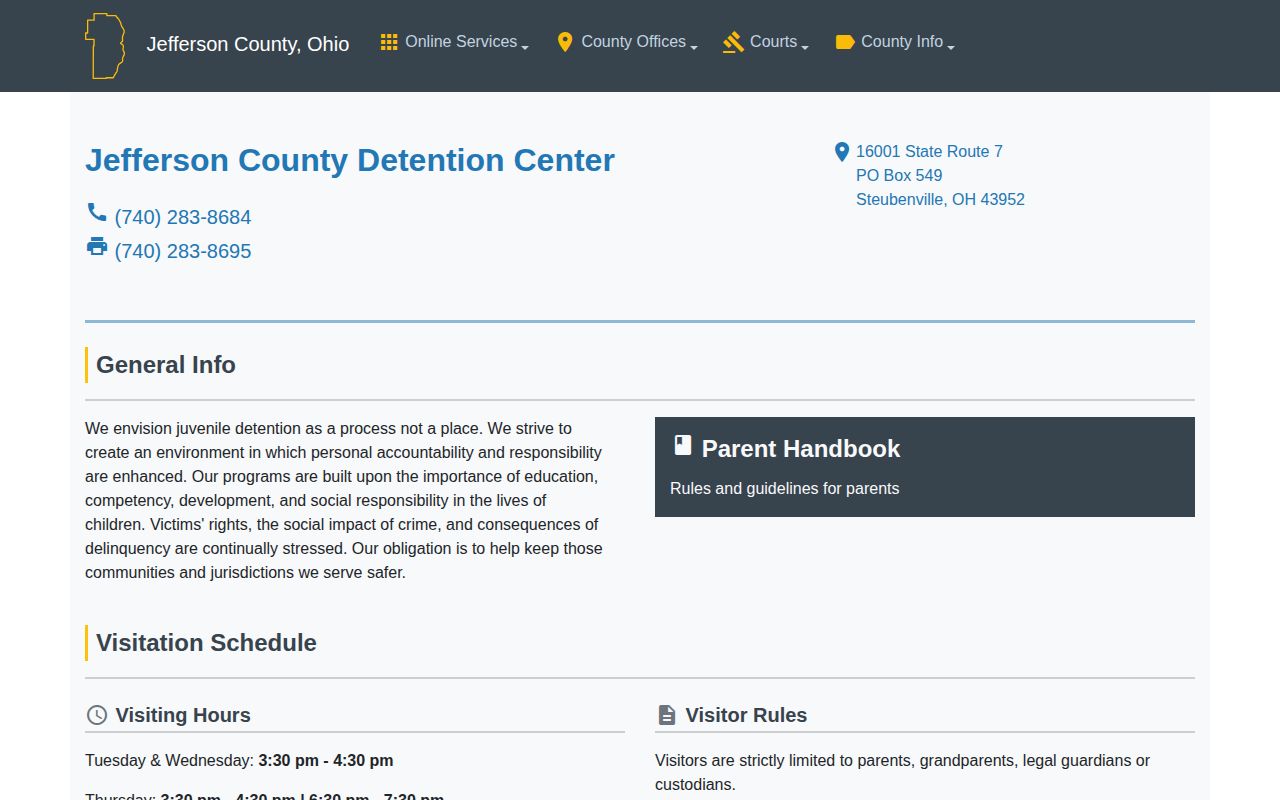
The page supports direct, authorized contact and does not establish a public adult-style release search. It also grounds the separate Juvenile Court identity that must remain clear anywhere the shared Justice Center address is shown.