
Jefferson County Projected Release Meaning
A projected release date is a calculation based on the sentence information then available. It is not the same as an actual release timestamp. The public ODRC label is “Expected Release Date/Parole Eligibility Date.” ODRC defines it as either a projected date or a date pending parole consideration. The dual label means a future date can mark the projected endpoint of a definite term, an old-law or life parole eligibility point, or one part of a modern indefinite sentence.
Read status before reading dates. INCARCERATED means the person remains in ODRC custody even if the expected date is close. APA SUPERVISION means the state custodial phase ended and supervision began. RELEASED with a judicial-release qualifier means a court ordered a state prisoner into community supervision. A death qualifier must never be described as a community return.
| ODRC label | Correct reading |
|---|---|
| Expected Release Date/Parole Eligibility Date | Projected endpoint or eligibility for parole consideration |
| POA/PRD Date | Parole on or after, or projected release date in its context |
| Earliest Possible Transfer Date | Potential transitional-control transfer, not assured community release |
| TC/TT Sentence Expiration | Projected release from a halfway-house placement |
| Supervision Start Date | Evidence that a supervised state release phase began |
| Expiration of Supervision Term | End of supervision, not the prison release date |
Find Jefferson County Projected Dates
Start with the last custodial system. The Jefferson County Jail and ODRC compute different kinds of terms. EOCC is a community-based correctional facility, not an ODRC prison. A federal sentence belongs in the BOP locator and sentence records. Using the wrong system can produce no result or a date that belongs to a different sentence phase.
- Obtain the sentencing entry. Note each count, degree, stated term, mandatory portion, concurrent or consecutive structure, effective date, and jail-time credit.
- For an Ohio state prisoner, open the ODRC Offender Search and search by ODRC number or a broad name query.
- Match the person through birth information, ODRC number, Jefferson commitment, docket, offenses, and sentence date.
- Read status, admission, jail-time credit, aggregate sentence, Expected Release Date/Parole Eligibility Date, POA/PRD, and hearing fields together.
- For a Jefferson County jail term, use the court entry and ask the jail at 740-284-3350 for the maintained sentence computation.
- When a public date conflicts with the judgment, request a narrow ODRC computation or Jefferson County release record rather than choosing one by guesswork.
The official ODRC definitions page shows why status, expected date, POA, and PRD cannot be treated as one field.
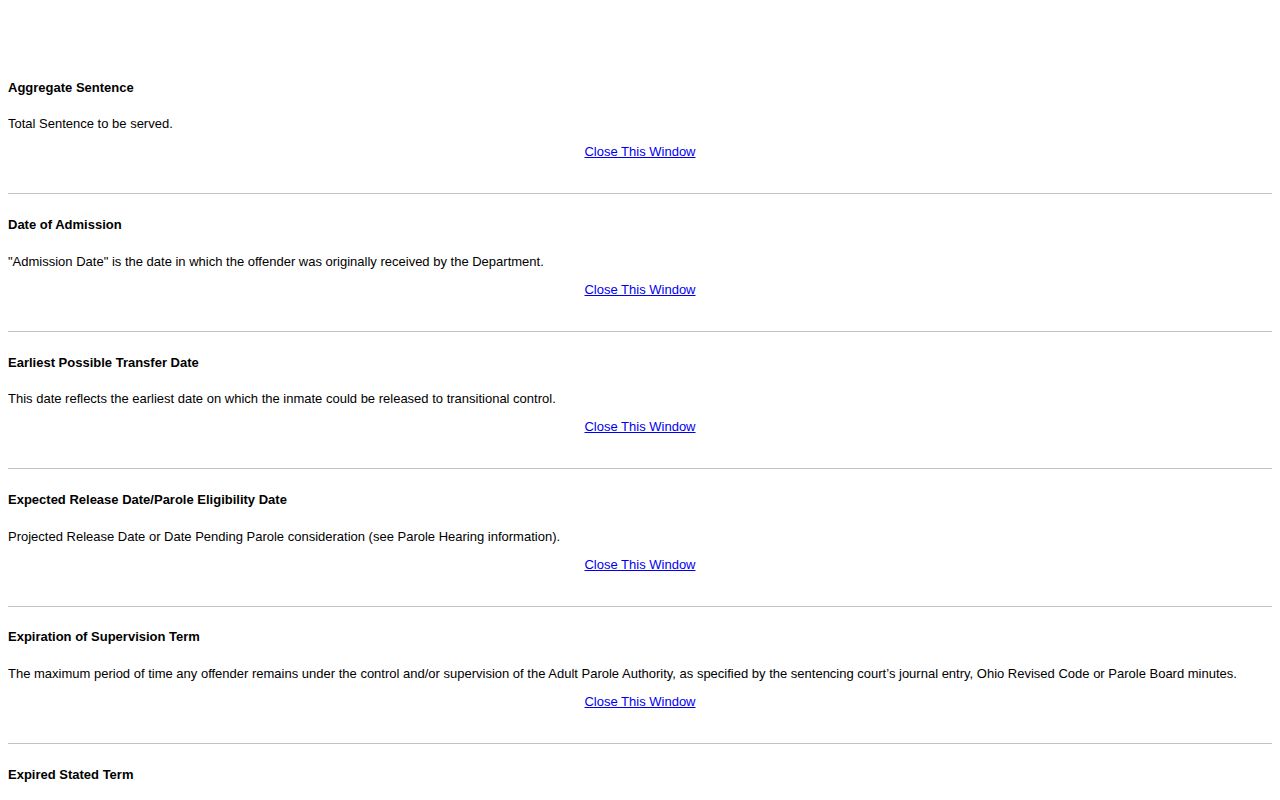
Use the definitions beside the person's detail so an eligibility date is not presented as a promised gate date.
Note: A pretrial Jefferson County detainee may have no fixed date because bond, court action, and other holds control release.
Jefferson County Release Calculation Layers
Ohio release math begins with the journal entry. It identifies the offense, sentence type, mandatory portions, whether terms run together or in sequence, and the effective date. R.C. 2967.191 governs credit for qualifying confinement before delivery to state custody. An error in the judgment or jail-time credit flows into the public expected date.
The next layer is the sentence regime. Traditional old-law indefinite sentences and some life terms use parole eligibility and Board discretion. Many modern definite sentences end at their stated term as reduced only by lawful credit. Eligible non-life indefinite sentences under R.C. 2967.271 carry a minimum and maximum. The law creates a release presumption at the minimum or presumptive earned early-release date, but permits rebuttal under the statutory process and confinement up to the maximum.
The third layer is credit. Program participation, completion awards, exclusions, withdrawal after rule violations, and the statute applicable to the sentence can all matter. A parole or transitional-control decision introduces another layer. Finally, detainers and new court actions can prevent a person from returning to the community even when one agency's term ends.
- Definite sentence
- A stated term with an endpoint calculated under the governing credit rules.
- Indefinite sentence
- A minimum-to-maximum term with a statutory release process.
- Parole eligibility
- The date consideration can begin, not an entitlement to release.
- Jail-time credit
- Qualifying prior confinement counted toward the sentence.
- Earned credit
- A lawful reduction based on eligible participation or completion under the controlling statute.
Ohio Credit and Jefferson Releases
Current R.C. 2967.194 permits provisional earned credit for eligible productive programs and activities. The monthly amount depends on the statutory category, and some completions may earn added credit. Mandatory terms and listed serious offenses or sentences are excluded. Credit may also be denied or withdrawn after rule violations. The ordinary aggregate participation and completion cap is generally tied to 15 percent of the stated term, apart from separately treated awards.
The predecessor R.C. 2967.193 remains relevant to the confinement and sentence periods it governs and uses a different framework, including an 8 percent limit in its context. O.A.C. 5120-2-06 supplies implementation detail. The date of the offense, sentence, and confinement must be checked before choosing which credit law applies.
“Serve 85 percent” is only shorthand for the reciprocal of the current ordinary 15 percent cap in an eligible definite-term setting. It is not a universal Ohio truth-in-sentencing rule. Mandatory time, exclusions, old-law and life cases, jail credit, special completion awards, and modern indefinite sentences alter the calculation. The actual statute and judgment control.
Note: Never subtract a flat percentage from the imposed term without checking sentence type, mandatory time, eligibility, and the governing statute.
Why Jefferson County Dates Change
A displayed date is a snapshot of the facts then entered. The court may correct the sentence or jail-time credit. ODRC can award, deny, or withdraw lawful credit. A Board outcome can continue consideration, establish a parole-on-or-after date, set a projected date, or undergo later review. Another court or agency may place a hold.
| Change | Effect on the date or release | Best confirmation |
|---|---|---|
| Jail-time credit correction | Moves the computed sentence point | Court entry and ODRC computation |
| Earned credit | May reduce an eligible term within statutory rules | ODRC computation and controlling statute |
| Disciplinary loss | May withdraw credit or affect release proceedings | ODRC record and current detail |
| Court action | Can modify, vacate, revoke, or judicially release | Sentencing-court journal |
| Parole decision | Can continue review or set POA/PRD timing | ODRC detail and official Board minute |
| Detainer or hold | May block community return after one custody ends | Holding and receiving agencies |
| Indefinite-sentence process | Can continue custody beyond the minimum toward the maximum | R.C. 2967.271 record and ODRC computation |
A favorable Board recommendation is not physical release. Likewise, an Earliest Possible Transfer Date can concern transitional control, and a TC/TT date can concern a halfway-house phase. The exact label and status carry more weight than the fact that a date appears.
Jefferson County Jail Date Limits
A county jail sentence is not calculated by copying ODRC's public expected date. Use the Jefferson sentencing entry, maintained jail credit, any applicable jail rules, and the jail's own computation. Research found no official Jefferson County good-time formula, weekend or holiday release rule, fixed discharge hour, discharge door, or online sentence calculator.
Call the Jefferson County Jail at 740-284-3350 and ask for the current status and the proper route for a maintained computation. For a durable record, send a targeted sheriff request identifying the person, booking, case, and requested date or calculation field. The sheriff public-record contact is kkelley@jeffersoncountysheriff.com. No fixed fee or turnaround is published.
A pretrial detainee is different. There is no sentence endpoint to compute. Bond, recognizance, dismissal, a plea or sentence, and other holds drive the event. A court order can authorize release without identifying the physical jail-door time. Confirm through both the docket and jail.
Confirm Jefferson County Actual Release
For a state prisoner, recheck ODRC status and the detail after the projected date. A Supervision Start Date, Released qualifier, release or parole detail, and Board action may clarify what occurred. The ODRC detail format shows how an incarcerated record can carry expected and eligibility information at the same time.
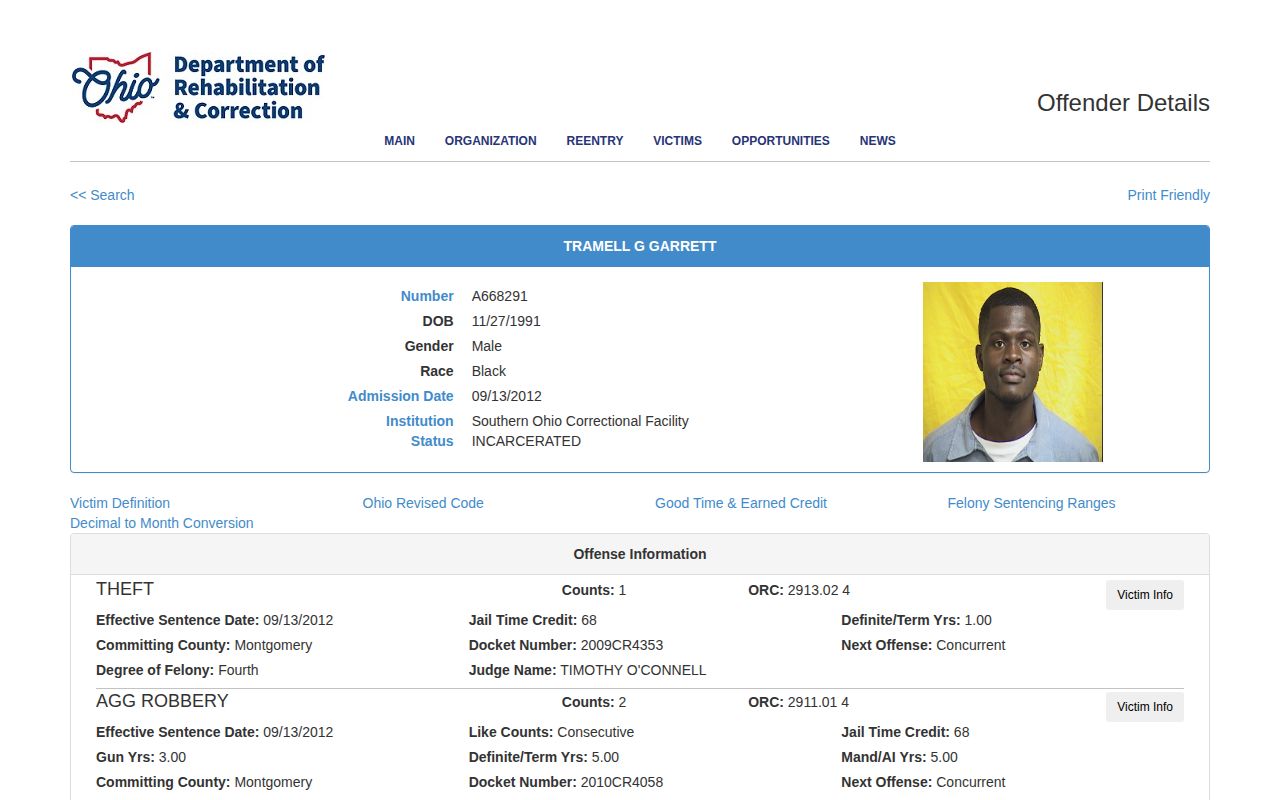
The image reinforces the need to read the custody status before treating either displayed date as an actual Jefferson County release.
Register for an offered custody event through the VINELink Release Check, but follow the Ohio Attorney General warning not to rely on VINE alone. Data can lag, and an alert does not explain the legal reason. Confirm a county-jail event with the jail and court. Confirm a state event with ODRC and the sentencing or Board record.
If the public detail and court judgment conflict, a narrow ODRC Central Records request can seek sentence-computation and release information that is publicly available. Mail may be directed to ODRC, Attn: Central Records, P.O. Box 430, Columbus, OH 43216. Broad inmate and APA files have statutory protection, so request the specific calculation, status, or action needed.
A parole date needs its own check. ODRC lets a search use Next Parole Board Hearing Date in YYYYMM form. A future month identifies a scheduled review period, not a release appointment. An individual result may later show the latest review type, result, or a POA/PRD date. If the public wording is too brief, request the official Board action or minute by name, ODRC number, and hearing month. Eligibility allows consideration; it does not assure a favorable result.
Federal dates remain outside the Jefferson County and ODRC calculations. The BOP locator can show a future projected date or a past release date. BOP cautions that federal sentence calculations can change, including through applicable federal credit rules. A result marked RELEASED means BOP custody ended. It does not prove that state custody, immigration custody, or supervised release also ended. Use that route only when the case is federal.
The durable answer is a chain of records: the sentencing judgment defines the term, the custodian computes it, the public system displays its current status, and the release record confirms what occurred. When any link conflicts, return to the office that created that part. Jefferson County courts can correct their entries. The jail can address its local computation. ODRC can address the state sentence and status fields.